27/04/2026
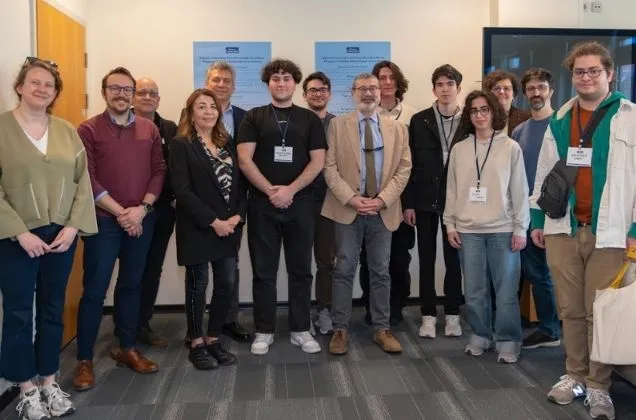
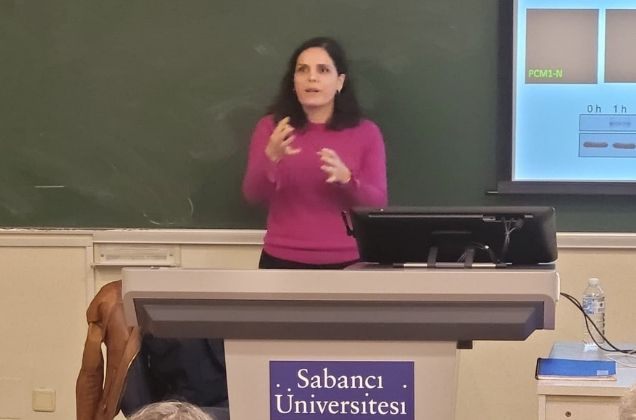
Associate Professor Dr. Elif Nur Fırat Karalar shared her current research on the dynamic organization of cells at Sabancı University as part of the Dean’s Speaker Series. Before the seminar, Umut Şahin, a faculty member at Sabancı University’s Faculty of Engineering and Natural Sciences, provided information about Karalar’s academic work. The seminar, attended by the Dean of the Faculty of Engineering and Natural Sciences, Prof. Dr. Erkay Savaş, and the Vice Dean, Prof. Dr. Burç Mısıroğlu, saw a large turnout of academics and students.
Dynamics of Cellular Organization
In her presentation titled “How Cells Build Dynamic Organizers: Centriolar Satellites in Health and Disease,” Associate Professor Dr. Elif Nur Fırat Karalar discussed the processes by which cells form complex structures.
In her presentation, Associate Professor Dr. Elif Nur Fırat Karalar stated that intracellular organization underlies cellular diversity and functional differentiation, and that this organization is particularly shaped through microtubule-based structures. Associate Professor Dr. Karalar, reminding the audience that the human body contains numerous cell types performing different functions, emphasized that this diversity is made possible by intracellular compartmentalization.
The presentation focused on centriolar satellites, which act as a dynamic bridge between structures such as the centrosome and cilium within the cell. Current findings on the formation processes of centriolar satellites were also shared in the seminar. Associate Professor Dr. Karalar stated that these organelles develop gradually in a specific order, mentioning three basic stages: initiation, rapid growth, and steady state.
In her widely followed seminar, Associate Professor Dr. Elif Nur Fırat Karalar emphasized that centriolar satellites are of great importance not only structurally but also functionally. She noted that these organelles play an active role in cilium formation, cellular signal transduction, and protein regulation mechanisms, drawing attention to their association with many neurological and developmental diseases. She also stated that these systems function like a dynamic "traffic network" ensuring the transport of proteins to the correct locations within the cell.
The seminar, held as part of the Dean’s Speaker Series, concluded after the participants' questions were answered. Bringing together leading scientists from different disciplines at Sabancı University, the series continues to be one of the important platforms for scientific sharing, thanks to the intense interest it has received to date. The Dean’s Speaker Series stands out as a strong reflection of Sabancı University’s vision of encouraging interdisciplinary research and bringing current scientific discussions to the campus.
About Assoc. Prof. Dr. Elif Nur Fırat Karalar
Dr. Elif Nur Fırat Karalar is an Associate Professor in the Department of Molecular Biology and Genetics and the Faculty of Medicine at Koç University, where she directs the Cytoskeleton Research Laboratory. Since 2025, she has also served as the Director of the Supported Research Office within the Office of the Vice President for Research and Innovation at Koç University. She received her PhD from the University of California, Berkeley, and completed her postdoctoral studies at Stanford University. Since establishing her own laboratory at Koç University in 2014, her research has focused on centrosomes, cilia, and centriolar satellites, aiming to understand how disruptions to these structures contribute to developmental and neurological diseases. Her work has been supported by significant national and international funding, including two projects from the European Research Council (ERC); she has also received prestigious awards such as the European Molecular Biology Organization (EMBO) Young Investigator Award, EMBO membership, and the TÜBİTAK Incentive Award.